Backed Into Your Garage Door? What to Do First
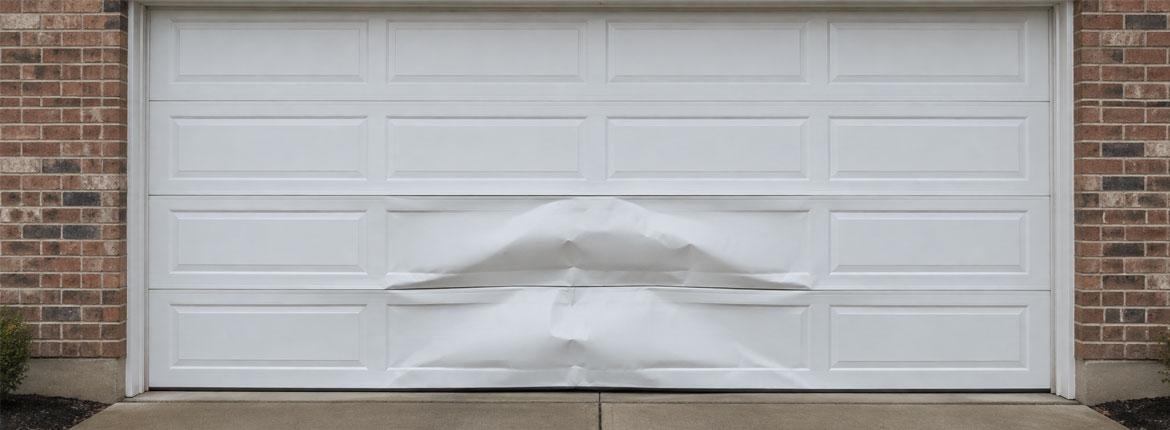
A garage door that has been backed into is a damaged door until someone checks the panels, the tracks and the rollers. A bent panel can pull the door off its track on the next cycle. Three calls decide everything after that: how to get the door open, whether to make a claim, and whether it needs one panel or a whole new door.
Start with the first ten minutes, because that is where people get hurt and where the bill grows.
Right now, before anything elseStop the opener by unplugging it at the ceiling outlet, so nobody presses a wall button. Keep people and pets clear of the door, and do not push or pry on a bent panel.
Then photograph the damage and phone (636) 577-1430. A typical door weighs 150 to 300 pounds, and one with a bent panel can drop without warning.
The repair itself is on our garage door panel replacement page. The estimate is free, and the technician checks the whole door, track and rollers included.
The First Ten Minutes After the Hit
Raynor, the door maker, says even simple collisions may result in injury. So the order below starts with people, not the door.
- Turn off the engine and set the parking brake. A running car can lurch forward into the door a second time.
- Check yourself and everyone who was in the car. Then check anyone standing in the garage. Door and panel damage can wait.
- Photograph the door before anything moves. Take the car, the dent and the track in one wide shot. Then take close shots of each bent spot.
- Unplug the opener. A hit door that tries to run can pull itself further out of line. Unplugging takes five seconds and removes the risk.
- Look from eight feet back, not from beside it. One Michigan dealer says to keep at least that far from a door that is off its rails or will not move. From there you can still see a crooked top edge, a gap at one side, or one side sitting higher.
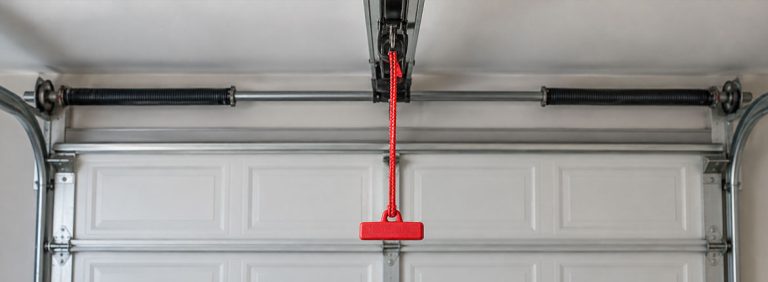
- Decide about the red release cord using the next section. This is the one step where ranking pages contradict each other. The garage door manual release guide explains the cord itself.
Should You Pull the Red Cord? It Depends on Where the Door Is
One dealer lists pulling the manual release as a first step for a bent or stuck door. A California dealer says the opposite for a door that is partly open, off track or damaged. A Wisconsin dealer sides with the California one and says to pull the cord only while the door is still closed.
The cord frees the door from the opener. If the door is resting on the floor, nothing can fall.
If a damaged track or cable is the only thing holding the door up, pulling the cord hands that job to the damage.
Swipe sideways to see every column of the table.
| Where the door is | Pull the cord? | Why |
|---|---|---|
| Closed, flat on the floor, edges even | Yes, then lift only if it moves freely | The door is down, so nothing can drop. If it binds, stop and leave it. |
| Partly open | No | The opener may be the only thing holding it, and a damaged track cannot guide it. |
| Crooked, or one side higher | No | The track or a cable has lost its grip on one corner. |
| Cable hanging loose, or a roller out of its track | No | That corner has lost its support, and a spring still holds a heavy load. |
A door stuck partway open is a phone call, not a project.
Four Things Not to Do With a Bent Door
- Do not push or hammer a bent panel flat. A Massachusetts dealer makes the point that every section must pass through the curved part of the track, and a panel that has lost its shape can bind there.
- Do not force it open or shut. A door that jams is telling you a roller, a hinge or the track has moved.
- Do not keep running the opener to see what happens. The opener will pull a damaged door harder than the track can take, and that is how a one-panel job becomes a track job.
- Do not touch the springs or the cables. They carry the full weight of the door, and a hit can leave them under load without looking it.
A door that now stops short or reverses on its way down is a different problem from a bent one. The garage door will not close guide takes that one apart.
What the Dent Is Hiding

The dent is the part everyone sees. On a hit door I check the track and the bottom roller first, because that is where the bill grows. Our panel page says the same: panel damage is often a symptom, so we diagnose the whole door before touching a tool.
Some of the damage shows from the driveway, and some only a technician finds.
- You can see it: a crease or a dent, a gap at the edge, a crooked top edge, a hanging cable, a roller out of the track.
- You can find it with a flashlight: a bent hinge, a kinked track section, a crack at the edge of a window section, a cracked bottom seal.
- Only a technician finds it: a track that is twisted just enough to bind, a spring or cable that took the shock, and a frame that has shifted.
- The photo eyes. They sit low on each side of the door, and a bumper can knock one out of line. The door may then refuse to close, and the dent has nothing to do with it.
A door that has left its track altogether is its own repair, and the garage door off track guide covers it.
One Panel or a Whole New Door?
Every page on this topic says it depends on the damage, the age and whether a matching panel exists. That is true, and it does not help you decide. Put prices beside it and the answer shows.
The numbers in the table come from two price lists: HomeGuide for panels and track, and HomeAdvisor for new doors. The new-door range is $754 to $1,707, and the average is about $1,231.
Judge any repair against half of that average, about $615, and against the age of the door. Past 15 years, put the new door first.
Swipe sideways to see every column of the table.
| What you find | Likely bill | Usual call |
|---|---|---|
| One creased panel, track straight | $300 to $900 for the panel | Replace the panel. A whole door is hard to justify. |
| Two creased panels, track straight | $600 to $1,800 for the panels | Price a whole door beside it. The top of that range passes the $1,231 average. |
| Two panels and a bent track | $725 to $2,100 with the track | Close to the $754 to $1,707 a new door costs. Compare the two quotes. |
| Three or more panels, or a crease at the opener arm | $900 to $2,700 for panels alone | Replace the door. One door dealer says a crease near the opener arm can make replacement the smarter choice. |
| A door over 15 years old, or a style no longer made | Any | Replace the door. Nothing matches to order, and the springs and track have aged too. |
The other test is the match. A door dealer warns that skins and finishes get discontinued, and a mismatch shows once the new section is on.
Our panel page lists three things we check: whether the style is still made, whether the size matches a current panel, and whether the hit bent a hinge, a strut or the track. If none of them match, the answer is the door, not the panel.
New doors are priced in the garage door installation cost guide, with the local figures.
How Your Door Build Changes the Call
Not every door fails the same way after a hit. Our panel page names three builds that behave differently.
- Steel. A steel section creases where the bumper met it. Steel panels also rust and fade with age, so an old door and a fresh section rarely look alike.
- Insulated. The new section must come back with its insulation and weather seal in place, the same as the section it replaces.
- Carriage-house, wood-look or custom. These take the most care to match. We double-check the color and the panel profile on every one.
Whose Insurance Pays, and Is a Claim Worth It?
Plymouth Rock, an auto insurer, spells out who pays. Your own car hitting your own door is not an auto claim for the door. Collision coverage pays for the car, and the homeowners policy pays for the door.
- You hit your own door: homeowners pays for the door. On a detached garage, Other Structures coverage may apply.
- You hit a neighbor’s door: your auto policy’s property damage liability pays for theirs.
- Someone else hit yours: their liability coverage pays. If they are uninsured or cannot be identified, your homeowners policy can cover it.
The deductible applies to each claim, says Triple-I, the insurance industry’s information group. Most homeowners insurers start theirs at $500 or $1,000, and some use a percentage of the home’s value instead.
Plymouth Rock adds that a repair near the size of the deductible is most likely not worth filing. Here is that rule in dollars.
Swipe sideways to see every column of the table.
| Repair bill | Insurer pays at a $500 deductible | Insurer pays at a $1,000 deductible |
|---|---|---|
| $300, one panel at the low end | $0 | $0 |
| $600, one panel | $100 | $0 |
| $900, one panel at the high end | $400 | $0 |
| $1,800, two panels and a track | $1,300 | $800 |
Those are examples, not quotes. The declarations page of your policy shows your deductible, and the written estimate below gives the bill.
Team AIS, an insurance agency, notes that frequent claims can raise premiums. A $100 payout on a $600 repair is a judgment call for the owner. A $1,300 payout is not.
Get the written estimate first. It is the number you set beside the deductible, and one national dealer says a repair estimate is a good idea before you file, though not required.
What a Written Estimate Should List
A California dealer notes that a written estimate speeds a claim. It also lets you compare a dealer’s number with the adjuster’s. A good one lists every item below.
- Each damaged section by position. Counted from the bottom, with what is wrong with it.
- Every part beyond the panel. Hinges, track sections, rollers, the bottom seal and the photo eyes, each on its own line.
- The panel itself. Make, model, size, color, insulation, and window layout, and whether a matching one can be ordered.
- A check of the springs and cables. A hit can strain both, and our panel page lists them in its checks.
- Labor, parts and one total. A signed total is something you can send to an adjuster.
Help the match along with photographs. Take the whole door straight on and each damaged section up close with a tape measure beside the dent.
Photograph the label on the end of a section or on the track as well. A door dealer says it shows the make and model, and it warns that guessing the gauge or the embossing gives a mismatch that is obvious once the section is installed.
What It Costs in St. Charles
Panels run $300 to $900 each, a track section $125 to $300 and a cable $145 to $165. One national dealer puts the average repair at $264, and most jobs land between $155 and $378.
A new door starts near $754 installed. A matching panel has to exist before a panel job is quoted, and the technician checks that on the visit.
Gateway works across St. Charles County, including O’Fallon, St. Peters and Wentzville.
The estimate on the free estimate page costs nothing. Send the written total to your insurer, and set it beside your deductible before you decide.
Where This Guide Stops
You cannot treat this page as a quote or as your policy. I cannot tell you what your insurer will pay, and the prices above are national averages from price lists, not a bid.
The advice here is not for a door nothing hit. If yours will not open and no car touched it, start with the garage door will not open guide instead.
Common Questions After Backing Into a Garage Door
Getting the Door Checked Before It Runs Again
Call (636) 577-1430 and say what hit the door, which side, and whether it moves at all. With those three facts the technician knows which parts to load and whether to price a new door.
Want proof before you book? The A+ rating for Gateway is there for you to check on the Better Business Bureau site. The owners are veterans, and the reviews page has what customers wrote after the work.
An unplugged opener leaves the door safe overnight, so the repair can wait until morning. Fill out the form on the free estimate page and the office phones you to set a time.