Standard Garage Door Sizes: What Fits and the Room It Needs
Standard garage door sizes start at 8 or 9 feet across and 7 feet high for one car. For two cars the standard opening is 16 feet across at the same height, and 8 feet tall is the common upgrade for trucks and SUVs. Fitting a door takes four more numbers, headroom, side room, backroom and floor slope, and the pages that rank for this search disagree on every one.
Measure the opening and the room around it before you order, not the old door.
Ordering a door soon?Write down five numbers: your opening width, your opening height at three points, the room on each side, the space above the opening and the depth of the garage. Then phone (636) 577-1430 and a specialist comes out to measure it for you.
Leave the padding to the dealer. Raw numbers are the safest thing to hand over.
Our garage door installation page lists single, double, quad and custom-size doors, and a specialist measures the opening before anything is ordered. The estimate is free.
The Standard Sizes at a Glance
Clopay, the door maker, names 8 by 7, 9 by 7 and 16 by 7 feet as the sizes most homes use. CHI Overhead Doors lists 8 by 7 for a single and 16 by 7 for a double.
Drag the table sideways to see all of its columns.
| Door | Size (wide by tall) | Where it fits |
|---|---|---|
| Single, older or compact | 8 by 7 feet | The long-time minimum, common in older homes and for compact cars |
| Single, modern | 9 by 7 feet | The popular choice in newer homes, with a little more room to park and open doors |
| Single, taller | 8 or 9 by 8 feet | SUVs, roof racks and cargo boxes |
| Single, wide | 10 by 7 or 8 feet | Full-size trucks and vans with wide mirrors |
| Double | 16 by 7 feet | The standard two-car door |
| Double, taller or wider | 16 by 8, or 18 by 7 or 8 feet | Two large trucks, or a garage that doubles as a workshop |
| Oversized or custom | 10 feet tall and up | RVs, lifted trucks and tall roof loads, made to order |
One slip to know about: a national home-improvement retailer files a 16 by 7 foot door under “single-car” in its size list. A 16 foot door is a double.
The door maker Garaga notes that two single doors and one double cost about the same. Choose by looks and by what happens if a door will not open, since one stuck double door traps both cars.
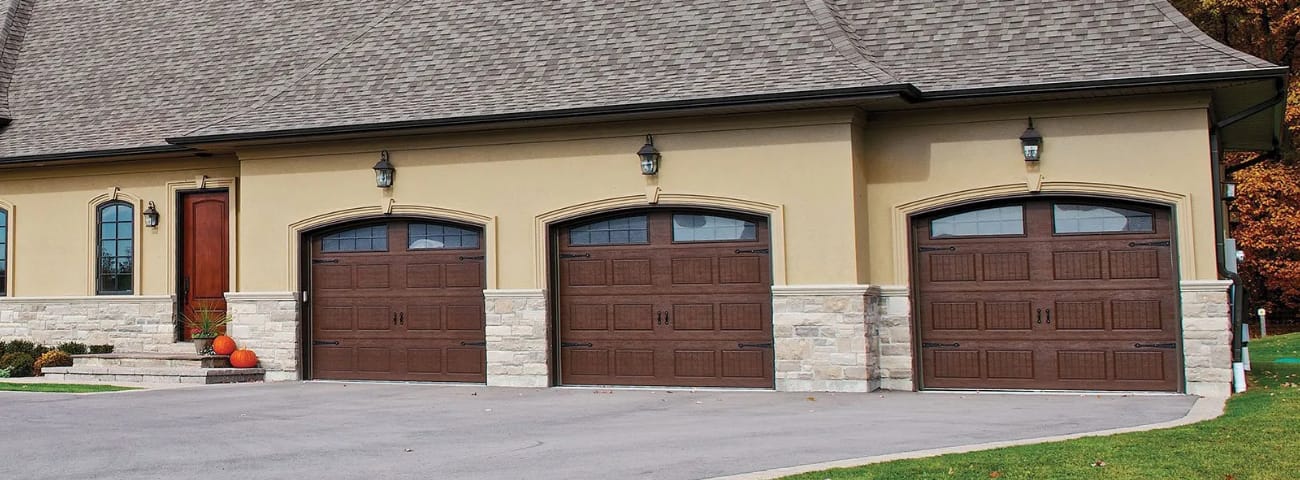
Which Size Fits Your Vehicles?
Drag the table sideways to see all of its columns.
| Vehicle | Door that fits | Why |
|---|---|---|
| Sedan or compact car | 8 or 9 wide, 7 tall | There is room to open the doors, and the roof clears with ease |
| Crossover, SUV or standard pickup | 9 wide, 7 or 8 tall | Wider mirrors and a taller roof than a sedan, so the extra foot of width helps |
| Full-size truck or van | 10 wide, 8 tall | Mirrors, a lift or a roof load need the extra width and height |
| RV or large camper | 12 by 12 feet or larger | Height is the limit, so these are ordered to size |
Dealer charts give nearly the same pairings. One adds a rule worth following: measure your widest vehicle with the mirrors out, plus any antenna or roof rack.
The Spruce reports that many trucks have lost a mirror in a 9 foot opening. If you drive one, the 10 foot width is the cheaper fix.
The Room Around the Opening, by Track Type
Every size above also needs space around it, and the pages that rank for this search disagree on how much. For the same standard door, one national franchise chart says 6 inches of headroom is enough and Family Handyman says 10 to 12. A regional door distributor says 12 to 15 for a torsion spring.
The Spruce prints “12 feet” of headroom for a manual door and “15 feet” for an automatic one, which can only be a slip for inches.
Each page can be right, because the room depends on the track. This table comes from Clopay’s track guide, and it is the one to trust for your own opening.
Drag the table sideways to see all of its columns.
| Track type | Headroom above the opening | Side room, each side | Backroom (garage depth) |
|---|---|---|---|
| Standard, 12 inch radius | 12 inches | 4.5 inches | Door height plus 16 inches |
| Standard, 15 inch radius | 14.25 inches | 4.5 inches | Door height plus 16 inches |
| Low headroom, spring at the front | 9 inches | 4.5 inches | Door height plus 23 inches |
| Low headroom, spring at the rear | 4.5 inches | 7.5 inches | Door height plus 30 inches |
| High lift | The lift height plus 9.5 inches | 4.5 inches or more | Door height plus 18 inches, usually |
Even Clopay lists lower figures in its sizing guide, 3-3/4 inches of side room and door height plus 18 inches of backroom. Those are general minimums. The track table is tied to a specific track, so use it.
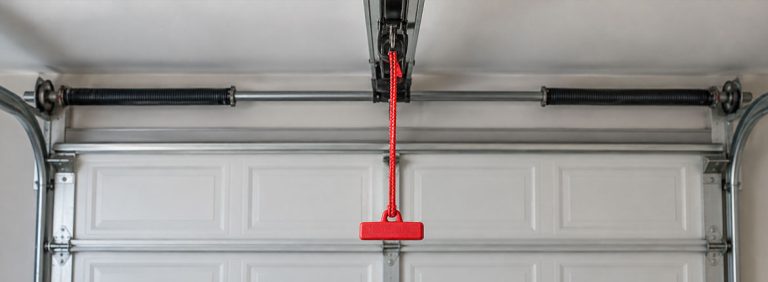
Extension springs run along the horizontal track, and a torsion spring turns on a shaft above the header. The spring that counterbalances the door needs that space, and so does the opener motor, which is why headroom decides which track fits.
A low ceiling is not the end of the road. Under about 10 inches of headroom, a regional door distributor points to a low-headroom track, which is the 9 inch and 4.5 inch rows above.
Where the Charts Disagree, and What to Write Down
Sizing pages also contradict each other on how to measure. The table shows each dispute and the safe thing to write down.
Drag the table sideways to see all of its columns.
| Question | What the pages say | What to write down |
|---|---|---|
| Is the door the same size as the opening? | Clopay says the opening equals the door. A national retailer says add an inch each side. CHI says add an inch or two to the width. | The raw opening width and height, and let the dealer set the allowance. |
| Which height do you use on a sloping floor? | One national retailer says the smallest. One dealer says the largest. Another says the highest and the lowest. | Height at the left, the center and the right. Write all three. |
| Can an oversized door be cut down? | Today’s Homeowner says yes. Family Handyman says steel, vinyl and fiberglass doors cannot be modified. | Order to size. Do not count on trimming. |
| How much room between parked cars? | One franchise chart says 2 feet. The Spruce says 3. | Plan for 3 feet. |
| Is the trim already on? | Family Handyman says 3/4 inch trim narrows the opening by 1-1/2 inches. | Measure the finished opening, trim included. |
When the pages disagree, do not guess which one is right. Write down the raw measurement and give it to the person who installs the door, because that person knows which allowance your door and track need.
How to Measure, in Order
A homeowner can take all of these with a tape measure. Take the width first, then three heights, next the room around the opening and finally the obstructions, and write each number down as you go.
- Width. Stretch the tape across the framed opening at its widest spot.
- Height, three times. Put the tape on the floor at the left, the center and the right, and run it up to the header each time. A sloping floor shows up here.
- Side room. Check the gap between each edge of the opening and the nearest wall or object. The track and springs sit in this space.
- Headroom. Hold the tape at the top of the opening and run it to whatever hangs lowest over the door, whether that is the ceiling, a pipe, a beam or a light.
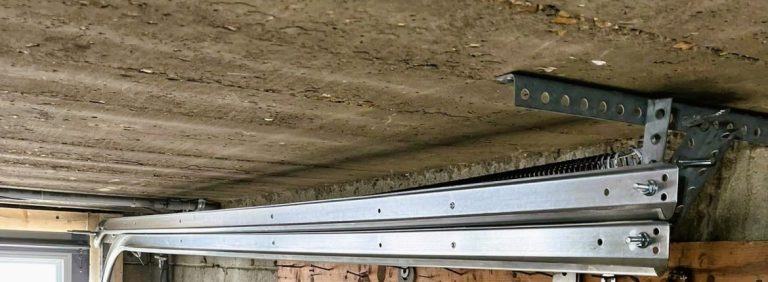
- Backroom. Follow the ceiling from the header to the back wall. The open door lies flat across this length.
- Obstructions. Note every pipe, light and duct in the path of the track.
What Size Does to the Price
Homewyse figures in our garage door installation cost guide put a one-car door anywhere from $844 to $3,498 once it is in, and a two-car door from $2,435 to $4,522. HomeAdvisor averages a replacement at about $1,231, inside a range of $754 to $1,707.
Size is part of the spread, but not all of it. Insulation, style and a new opener move the number too.
Family Handyman warns that a door for a nonstandard opening costs a lot more than one for a standard opening. One national franchise chart puts an oversized or custom door at $3,000 and up. CHI adds that common sizes are in stock more often and ship sooner.
One door or two? A national retailer says two single doors and one double take about the same budget, and that the two singles need two openers.
A national franchise chart says one large door usually costs less than two. Get both quotes before you decide.
Check the Opener Fits Too
The opener needs room as well. A national retailer says an opener needs about 3 more inches of clearance above the door, and that the backroom can depend on the opener you choose.
A wall-mount opener needs side room instead, 3.75 to 5 inches according to a regional door distributor. Our garage door openers page shows the LiftMaster and Genie units we install.
When to Have Someone Measure It
Call for a measure if the headroom is under about 10 inches. Call too if your ceiling is tall enough for a high-lift track, your floor slopes or your opening is not square. These are the cases where one wrong number means a second trip and a return.
Changing the size of the opening is a different job. A national franchise guide says it can be done, but building and permit codes apply, so the framing belongs to a builder before any door is ordered.
A Gateway specialist visits homes in Wentzville, O’Fallon, St. Peters and the rest of St. Charles County, measures your opening, then lists the options and quotes the garage door installation.
Where This Guide Stops
You cannot order a door from this page or from any chart, because no chart knows your framing. A specialist measure is necessary before an order, and a standard size takes less time to get than a custom one.
I cannot see your opening from here, and a garage with an odd ceiling or a sloped floor may break every rule in the table. Treat the numbers as the starting point and let the measure decide.
The advice here is not for a commercial roll-up door or a door on a barn or shed. Those use different sizes, tracks and clearances.
Common Questions About Standard Garage Door Sizes
Getting Your Opening Measured
Call (636) 577-1430 and tell the office your opening width, how many cars you park and whether you drive a truck. Those three facts let the specialist plan the visit.
Look Gateway up on the Better Business Bureau and you will find an A+ rating. Veterans own the company, and you can read what customers say on the reviews page.
Prefer to start in writing? Add your numbers on the free estimate page and a staff member returns your call to set the visit.