Garage Door Cable Broke on One Side: What It Means and What to Do Now
If your garage door cable broke on one side, the lift cable on that side has let go, so the spring now lifts only the other side and the door sits crooked. One cable is holding what two were built to hold.
Right nowThree things come first. Leave the opener button alone, keep your hands off the door, and keep people, pets and the car out from under it. Then call (636) 577-1430.
A technician replaces both cables in one to two hours. The garage door repair service page prices a cable repair at $145 to $165. You cannot tell from the floor whether the drum or the spring is also done, so when I quote a cable job, I look at the drums and the spring before I give a price.
What a Lift Cable Does, and Why One Side Drops
Two lift cables carry your door. Each is braided galvanized steel, 1/8 inch or 3/32 inch thick on most homes, the sizes HomeGuide lists for residential doors. One end hooks to the bottom bracket at each lower corner of the door, and the other end winds onto a grooved drum at each end of the torsion shaft above the opening.
The torsion spring turns that shaft. The drums wind the cables in, and the cables lift a door that weighs 150 to 400 pounds. So the spring does the lifting, and the cables only deliver it, one to each side.
“Broke on one side” covers three different failures:
- Snapped. Strands rusted or wore through and the cable parted, often with a bang.
- Frayed. Broken strands are showing, but the cable still holds. This is the one to catch early.
- Unwound. The cable is in one piece but has come off its drum and hangs slack. That usually follows a door that was stopped by something on the way down, or a spring that let go.
In all three the result is the same. The good side still lifts and the bad side does not, so the door tilts and the rollers on the low corner bind in the track. If the opener keeps pulling, it drags the door off the track.
Your door may carry other cables too. Older doors with extension springs run their lift cables over pulleys instead of drums, and they carry a thin safety cable threaded through each spring. The red cord on the opener is a release cord, not a lift cable, and none of those is what broke here.
Is It the Cable or the Spring? A 60-Second Check From the Doorway

A broken torsion spring is the most common reason a cable goes slack, and the two get mixed up all the time. One Garage Journal thread in Google’s results for this problem is titled “need help with garage cables.” It runs 40 replies before the owner looks up and finds his spring in two pieces.
You can sort it out without touching anything. Stand in the doorway and look for these:
| What you see | Points to |
|---|---|
| The door sits crooked, one bottom corner lower than the other | Cable on the low side |
| One cable hangs loose or lies coiled on the floor, the other is tight | Cable on that side |
| Both cables are slack and the door is level | Spring, or drums that slipped on the shaft |
| A gap of about 2 inches in the coil of the spring above the door | Spring |
| The door lifted a few inches, stopped, and is still level | Spring |
| You heard a bang from the garage earlier | Either, and a spring snap is usually the louder of the two |
The difference matters because the two failures travel together. When a spring breaks, the whole weight of the door drops onto the cables at once, and one of them often snaps with it. So a spring job usually includes new cables, and a cable job always includes a look at the spring.
If you found the gap, what you need is garage door spring repair. The guide to spring repair and replacement explains the two spring types and what each costs.
What to Do Right Now, by Where the Door Stopped
Where the door came to rest decides what is safe. The opener gets unplugged in every case, because a remote in a car or a child at the keypad restarts the motor against a jammed door. Pull the plug from the ceiling outlet, or switch off the breaker.
| Where the door is | Do this | Leave alone |
|---|---|---|
| Down, with the car inside | Leave it down. Unplug the opener. Call and say the car is inside. | The release cord, and any plan to heave it up by hand |
| Part way up and crooked | Unplug the opener. Keep everyone out from under it. Call. | The button, and the door itself, in either direction |
| Fully up | Leave it up. Unplug the opener. Park outside. Call. | The red release cord |
The red cord is the one people reach for, and it stays alone while the door is up for one reason. Pulling it disconnects the door from the opener’s trolley, chain-drive or belt-drive, and with the door up that trolley is one of the few things still holding a door that has lost half its lift. Let go of it and a crooked door can come down on its own.
Some repair guides say to pull the cord so the opener cannot run. Unplugging the opener does that same job without letting go of the door, so unplug it instead.
Can you open it by hand instead? With one cable gone the door is out of balance, so one side is far heavier than the other. You would be lifting most of a 150 to 400 pound door on one side while the other side binds in the track, so the answer is no.
A door that is sitting crooked is a cable job. One that was forced, and is now off its track with a creased panel, costs a cable job plus a track and often a panel. If I could get one thing across, it is that the second kind always starts as the first kind.
Why Cables Break in St. Charles County
A lift cable lasts 7 to 10 years in normal use, by HomeGuide’s figure, and A1 Garage puts wear at about 10,000 cycles. Five things cut that short around here:
- Rust at the bottom. A cable fails where moisture sits, at the bottom bracket near the floor. In St. Charles, St. Peters and O’Fallon that corner gets summer humidity and winter slush that drips off the car and dries to salt. A rusted strand is a strand ready to break.
- A spring that broke first. The door’s full weight hits the cables in an instant, and the weaker of the two goes.
- A door that was forced. Run past something on the floor, or run again after it jumped the track, the cable goes slack for a second and jumps its drum. The same thing happens on every close when the opener is set to travel too high.
- A bottom seal frozen to the slab. On a January morning in Wentzville or Cottleville the rubber seal freezes to the concrete. Press the button and the motor pulls the top panel up while the bottom panel is still iced to the floor, so the cable goes slack and jumps the drum before the ice lets go.
- Worn drums, pulleys or bearings. A grooved drum or a pulley with a bad bearing chews cable. Cables set with uneven tension at installation wear faster on one side, which is why only one side breaks.
Missouri’s freeze-thaw cycle works the metal too. Every cold snap shrinks the galvanized steel and every thaw lets it go, so a cable here ages faster than the same cable in a mild climate, and an insulated double door loads it harder than a single. A frayed strand you can see is the warning, and the six signs of a broken garage door guide shows what a frayed cable looks like before it lets go.
What the Repair Involves, and Why Both Cables Get Replaced
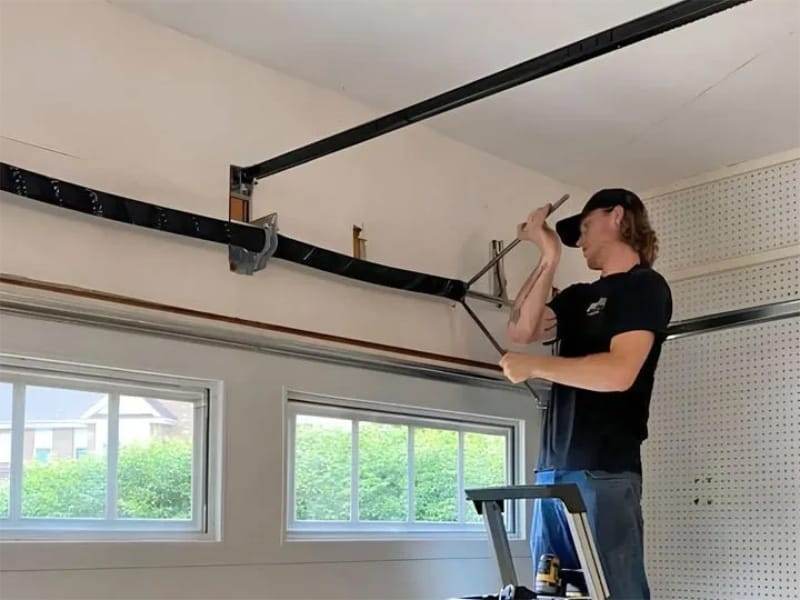
The repair runs in this order, and the order is what you are paying for:
- Secure the door and release the spring tension with winding bars. This is the dangerous part, and it is the reason this is not a homeowner job.
- Fit new cables as a matched pair. Both cables have the same age and the same cycles, so the survivor is only months behind the one that broke.
- Check the drums, the bottom brackets and the spring. A cable failure usually points at something else that is wearing.
- Re-tension, balance the door, and test the opener’s auto-reverse before leaving.
HomeGuide puts the job at 1 to 2 hours for a standard residential door, and the parts at $20 to $50. The price is the training and the tools, not the cable.
Nothing here teaches you to re-cable the door. Pages online walk you through loosening the drum set screws and winding the spring, and the spring stores the force of the whole door.
A neighborhood Facebook thread in Google’s results for this question has a woman describing a neighbor hurt badly when a cable let go during a DIY attempt. I do this work, and I would not do it without the training.
What a Cable Repair Costs in St. Charles
On the garage door repair page a cable repair runs $145 to $165, and the on-site estimate is free. HomeGuide’s October 2025 cost guide puts the national range at $150 to $350. Replacing both cables runs $150 to $250 there, and an emergency call $250 to $350 or more, while A1 Garage, a national chain, prices cable replacement at $250 to $400.
The bill grows when the door was run crooked. HomeGuide’s price list has track replacement at $125 to $300 and a creased panel at $300 to $900 per panel, which is the garage door panel replacement service.
A spring that broke with the cable adds a spring replacement, listed on the repair page at $175 to $275. Anything more detailed on price belongs on the repair page, not here.
Where This Guide Stops
The crooked door with one cable gone is the only case this guide covers. It is not for a door that has left the track on both sides, and it is not a repair manual, so three cases belong elsewhere:
- A door that will not move at all, and sits level, is usually power, a spring or the opener. The garage door will not open guide has the three checks, in order.
- A motor that runs while nothing moves is an opener fault. Start with garage door opener troubleshooting.
- When the door has left the track on both sides, it is a track job first, and the cables come second. The garage door off track guide covers that case.
Common Questions About a Broken Garage Door Cable
Getting It Fixed
Call (636) 577-1430 and tell us where the door stopped. When you call, a technician comes out, checks the cables, drums and spring, and gives you the price before any work starts. The on-site estimate is free.
Look us up before you let anyone near the spring. Gateway is veteran-owned and family-run, and its A+ rating is on its public Better Business Bureau profile. On the reviews page customers describe their own repairs in their own words.
When the door is down and it can wait until morning, book a free estimate online and you will get a call back to set a time.